
Time Dilation Theory
Gravity through time.

Background Info.
Resolving that my ideas were in error I solicited advice and direction from noted theoretical physicist Roy D. Herbert. I asked Roy how his theory could be part of a device such as the ARV (Flux Liner).
Initially I thought Roy’s theory of how time creates gravity might be difficult to grasp, but the crux of the theory is straight forward, and while admittedly the execution might be something else altogether it does appear this is how gravity actually does work.
If you think upon time producing gravity it is not an entirely alien concept, and this is because time is a part of the equation defining the speed of an object over a measured amount of distance, and then inertia is commonly and often linked to velocity/speed, and so the ideas combine to produces an innate logic of time as a measure of inertia.
How can dilation theory work in the physical world to produce gravity? Read Roy’s words so that you have your own thoughts.
“An extended state (electrons) invokes geometric symmetries of a quanta like phase, and which holds a different temporal rate, a much faster rate, and that will provide the zero inertial state with that added temporal rate: Any directed form of entropy will provide free fall (*as such) in the direction of the directed entropy; microwaves, sound waves, any~” Roy D. Herbert.
If correct then this is gravity defined, but is it correct, well the evidence does support that it is the case.
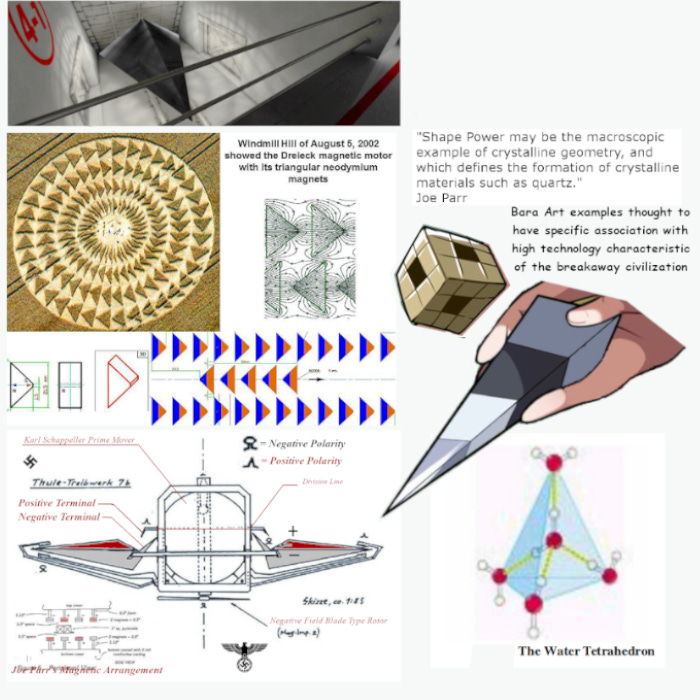
Paraphrasing next paragraph.
{An environment can hold a much faster relative rate of time by way of reproducing a microcosmic geodesic at a macrocosmic scale.}
A quanta, the smallest particle of energy, is defined by the geometric shape of a tetrahedron (*my understanding). Such a shape mirrors the geometry of a quanta of energy which is moving at a much faster temporal rate of time. So for example a Neutron Star is spinning at some fantastical rate and is thus acting/behaving like it were a quanta of energy.
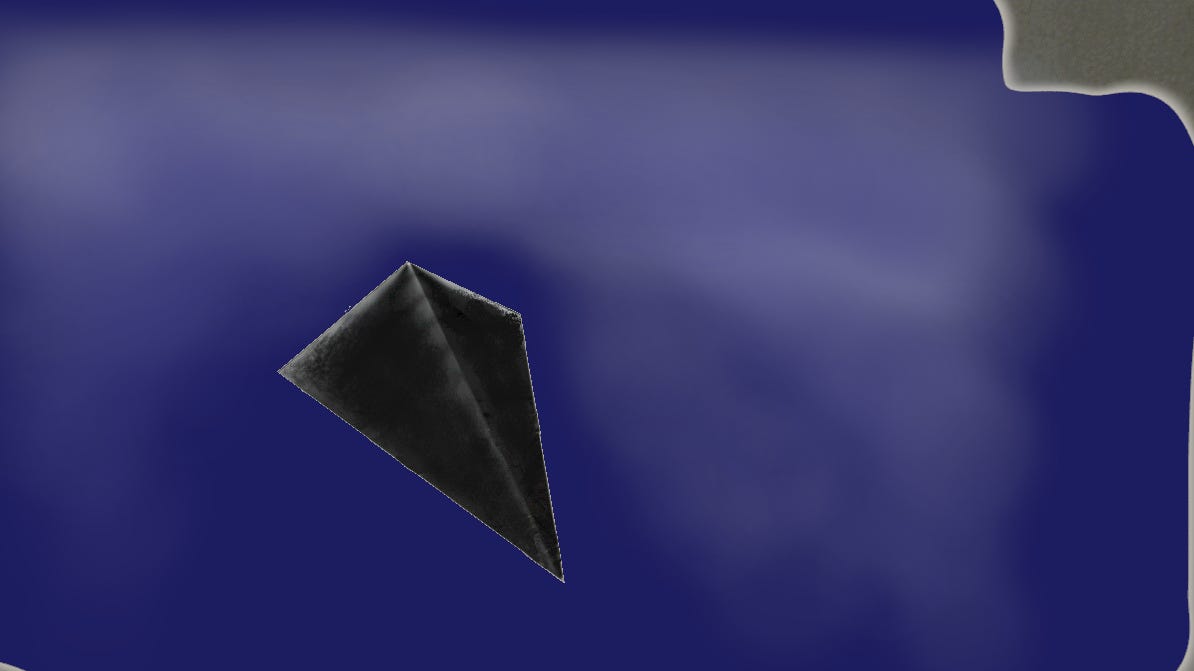
UFO’s/UAP have been known to assume geometric structures which are tetrahedronal/diamond/pyramidal; these are basic geometric forms of quanta. As such the geometry denotes a mimicking a quanta of energy on a macroscale akin to what a Neutron Star does: A logical conclusion might be the visualization of geometrical shapes are the result of a differential temporal field, and another seemingly logical conclusion is that these objects must then be working as though they were a macroscale form of quanta. That is to say, their behavior is fundamentally the same, and so the temporal field should logically be one of a much faster rate of time.
Roy often uses a neutron star to explains how a macroscale object such as neutron star behaves as a quanta; where the star has assumed the behavior a quanta through a coherency of quanta, and such that the whole now has the same behavior as a single quanta of energy. Thus the entire star has a vastly higher temporal rate. If you go listen to Roy you will hear him describe this.
Now an attempt to move into a mechanistic approach to the previous.
Now for reference I was asking Roy for design guidance and referencing the McCandlish ARV illustration. The notes to the McCandlish illustration were added by me as additional information that Mark himself passed on to me through an email when I purchased some prints. So those are my added notes as provided to me on the so-called capacitors material composition. *Specifically notice bismuth in the callout notes.
So FYI here, Roy apparently glanced at this and grasped what they were trying to do, and which is alluded to in the information. I think Roy saw that and immediately grasped the gist of the design.
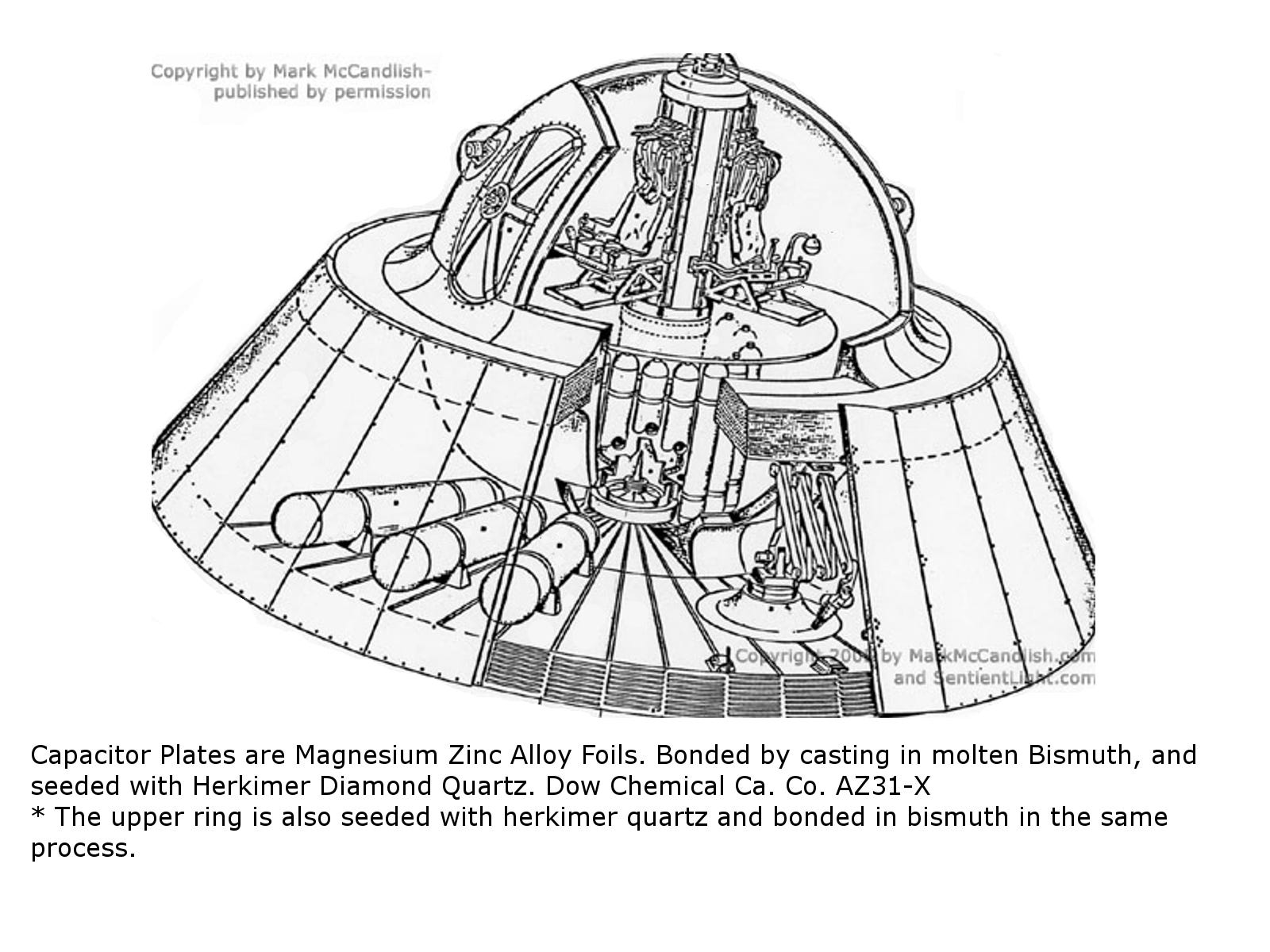
Recall that the ARV was said to be engulfed in air which was significantly cooler than the very hot air surrounding it when it was reportedly observed inside a hot desert aircraft hanger. That quality suggests a quantum super conductive state, which is a quality of a quanta of energy as I understand, and so if the machine is mimicking a quanta it stands to reason that it is in a superconductive state which would explain the surrounding air being cold.
Now look at the central column of the McCandlish Illustration. Hmm..
You may want to call up some video’s on the ARV and do some screen captures to see Mark’s sketches of the interior of the central column. This thing is doing what Roy describes in the following.
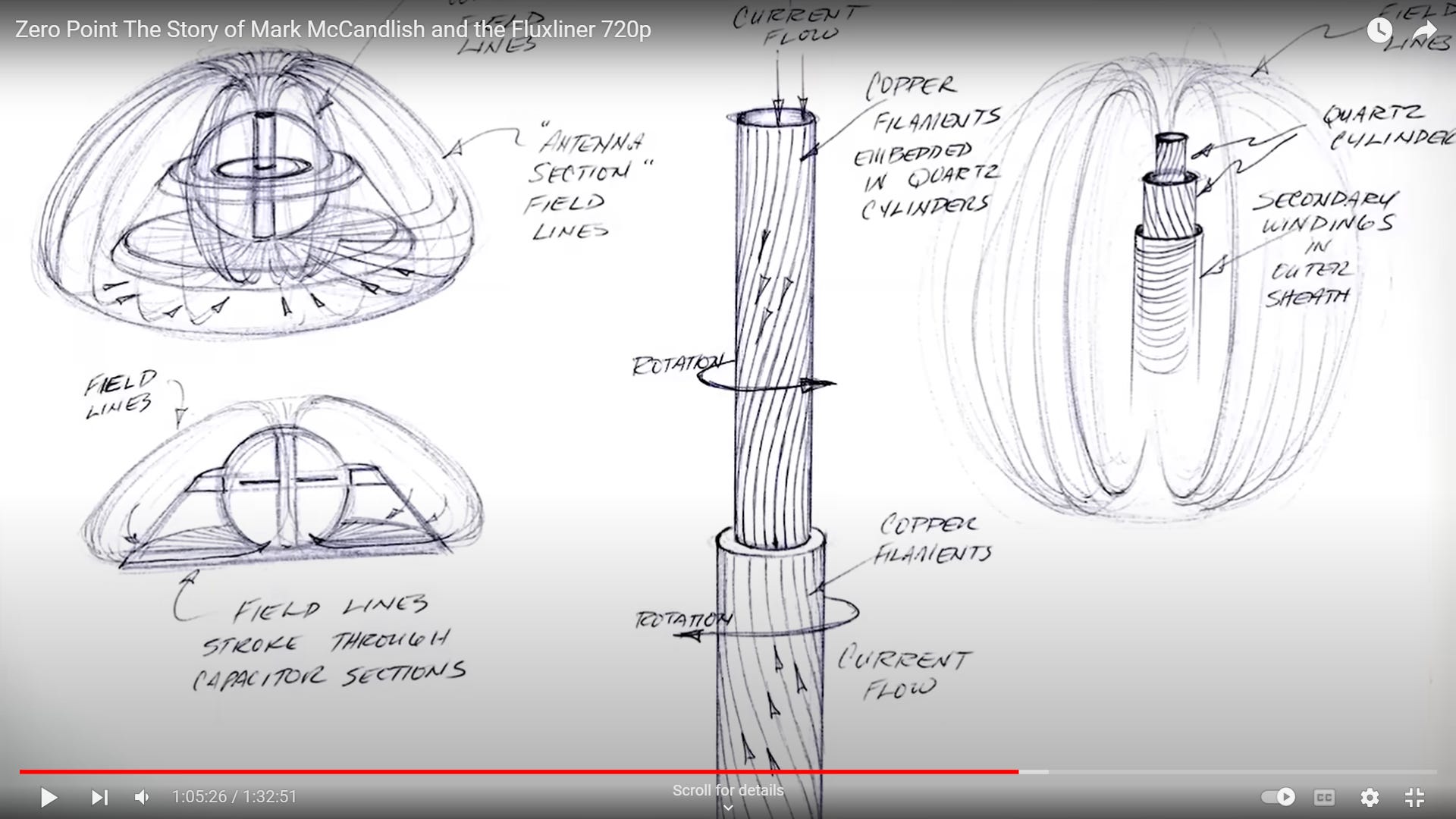
Screen capture from the video “Zero Point: The Story of Mark McCandlish and the Fluxliner.
“A diamagnetic fluid behind a high orbital metamaterial will extend the electrons providing phase transition. That transitional environment holds a much faster rate of time. This provides two attributes in one, a separation for the larger scale geodesic to that of the macrocosm to microcosm, and a faster temporal rate.” Roy D. Herbert.
The rest of the following are questions and responses from ChatGPT. * Just some examples of using AI.
ChatGPT said:
ChatGPT
Plasmon resonance refers to the phenomenon where free electrons on the surface of a material, typically a metal like gold or silver, oscillate collectively in response to an external electromagnetic field, such as light. When the frequency of the external field matches the natural frequency of these electron oscillations, resonance occurs, leading to a significant enhancement in the intensity of the electromagnetic field at the material’s surface.
There are two main types of plasmon resonances:
Surface Plasmon Resonance (SPR): This occurs at the interface between a metal and a dielectric (non-conducting material). It involves the collective oscillation of surface electrons in response to light, which travels along the surface of the material. SPR is widely used in sensors to detect molecular interactions.
Localized Surface Plasmon Resonance (LSPR): This occurs in metallic nanoparticles, where the free electrons in the particle oscillate locally. LSPR leads to strong light absorption and scattering, and it is highly sensitive to the size, shape, and surrounding environment of the nanoparticles. LSPR is used in applications like biosensing, imaging, and nanophotonics.
Both forms of plasmon resonance result in enhanced electromagnetic fields at the surface, and their resonance frequencies can be tuned by altering the size, shape, or material of the nanoparticles or surfaces, making them valuable for various scientific and technological applications.
Bismuth and metamaterials.
Bismuth itself is not considered a metamaterial. It is a naturally occurring element with unique properties, such as low toxicity, high density, and unusual electrical behavior (it is a poor conductor of electricity). It also has a low thermal conductivity and expands when it solidifies, unlike most metals.
However, metamaterials are engineered materials designed to have properties that are not found in naturally occurring substances. They often manipulate electromagnetic waves, such as light or sound, in ways that natural materials cannot. Metamaterials usually consist of complex structures built from smaller units (which can be made from materials like metals, plastics, etc.) that interact with waves in unique ways.
While bismuth may not be a metamaterial by itself, it can be used as a component in the design of metamaterials. For instance, bismuth's diamagnetic properties or its unusual electronic characteristics can potentially be incorporated into a metamaterial design to achieve specific effects, like manipulating electromagnetic fields. But the key here is that bismuth would be a building block, not the entire metamaterial.
What metamaterials incorporate bismuth?
ChatGPT said:
ChatGPT
Bismuth is sometimes used in metamaterial designs due to its unique properties, but it is not the most common element used in these materials. However, there are a few specific areas where bismuth or bismuth-based compounds have been incorporated into metamaterials:
1. Bismuth-based Topological Insulators
Bismuth compounds, such as bismuth selenide (Bi₂Se₃) and bismuth telluride (Bi₂Te₃), are known as topological insulators. These materials behave as insulators in their bulk but conduct electricity on their surface.
Metamaterial applications: These properties make them useful for designing metasurfaces that can manipulate light or other electromagnetic waves in novel ways, particularly in photonics or quantum computing systems.
Topological insulators are a hot topic in electromagnetic metamaterials because they offer low-loss surface conduction and potential for unique electromagnetic waveguiding.
2. Bismuth in Magneto-Optical Metamaterials
Bismuth-doped materials can be used in magneto-optical metamaterials, which manipulate light in the presence of a magnetic field.
Bismuth-based materials exhibit high magneto-optical activity (the ability to change the polarization of light under a magnetic field). This can be useful in the design of optical isolators, circulators, or filters within metamaterials, particularly at terahertz frequencies.
3. Bismuth Ferrite (BiFeO₃) in Multiferroic Metamaterials
Bismuth ferrite (BiFeO₃) is a multiferroic material, meaning it exhibits both ferroelectricity and magnetism.
Applications: BiFeO₃ is used in creating metamaterials that can be tuned by external electric or magnetic fields, which is useful for creating materials with tunable refractive indices or for developing devices like frequency-tunable filters.
4. Bismuth in Photonic Crystals
Bismuth can be used in photonic crystals, a type of optical metamaterial that affects the motion of photons.
Bismuth-based photonic crystals may have specific applications in controlling light propagation or creating band gaps for particular wavelengths of light, particularly in the infrared and terahertz ranges.
Summary
Bismuth's role in metamaterials usually comes from bismuth-based compounds rather than the pure element. These compounds can provide useful properties like topological insulation, magneto-optical effects, and multiferroic behavior, which can be harnessed in advanced metamaterial designs for applications ranging from optical devices to quantum computing and waveguiding systems.
Let me know if you'd like further details on any of these applications!
:
ChatGPT, tell me a bismuth metamaterial which if induced with an electric charge produces an extended state electron
ChatGPT said:
ChatGPT
The specific phenomenon you're referring to, where a material induced with an electric charge produces extended state electrons, can be found in topological insulators, particularly those based on bismuth compounds. Let me walk you through a specific example:
Bismuth-Based Topological Insulators
A well-known example of a bismuth-based metamaterial that exhibits this behavior is bismuth selenide (Bi₂Se₃) or bismuth telluride (Bi₂Te₃). These materials are classified as 3D topological insulators (TIs), a special class of quantum materials that have insulating properties in the bulk but possess metallic surface states where electrons are free to move (i.e., extended states).
Extended State Electrons
When a topological insulator like bismuth selenide is induced with an electric charge or subjected to an external electric field, electrons in the bulk remain localized (due to the insulating nature of the material). However, the surface states exhibit what are known as extended electron states. This means that:
Surface electrons behave as if they are massless and can travel along the surface of the material without being scattered (protected by time-reversal symmetry).
The extended electron states are topologically protected, meaning they are resistant to imperfections in the material, making these surface states highly robust against backscattering by non-magnetic impurities or defects.
How This Works
The surface of a topological insulator like bismuth selenide has an unusual band structure that allows electrons to behave more like relativistic particles, akin to Dirac fermions. When an electric charge or voltage is applied, it induces current flow on the surface of the material, and these extended state electrons exhibit:
High mobility along the surface.
A spin-momentum locking mechanism, where the electron's spin is locked perpendicular to its momentum. This reduces scattering and leads to efficient conduction at the surface.
Applications of Extended State Electrons
Quantum Computing: These extended states in bismuth-based topological insulators could be used in quantum computing applications where qubits require long coherence times and resilience to environmental disturbances.
Spintronics: Because of the spin-momentum locking effect, bismuth-based topological insulators could also be applied in spintronic devices that exploit electron spin rather than just charge for information processing.
Surface Conductivity: The surface conduction from extended electrons is being explored for low-dissipation electronic devices where reduced energy losses during electron flow are essential.
Example: Bismuth Selenide (Bi₂Se₃)
Material: Bismuth selenide (Bi₂Se₃), one of the most studied topological insulators, has a bulk insulating gap and surface conducting states.
Electric charge induction: When a voltage or electric charge is applied, surface electrons transition into extended states where they are free to move across the surface, behaving similarly to massless particles.
Metamaterial aspect: The topologically protected surface states of Bi₂Se₃ are a form of metamaterial property, arising from its engineered electronic band structure.
In this case, the induced electric charge enables the extended state electrons at the surface to exhibit exotic properties, such as spin-momentum locking and high mobility, which can be utilized in advanced electronics or quantum devices.
Summary
A metamaterial like bismuth selenide (Bi₂Se₃), when induced with an electric charge, produces extended state electrons at its surface. These electrons are topologically protected and exist in extended states that allow them to conduct efficiently along the surface, offering potential applications in quantum computing and spintronics.
You said:
Thank You ChatGPT, that was very helpful, and can you now provide a list of metamaterials that feature an extended electron state when induced with an electric charge?
ChatGPT said:
ChatGPT
You're welcome! I'm glad the information was helpful. Now, let's explore a list of metamaterials that exhibit extended electron states when induced with an electric charge, many of which are part of the topological insulator family or other advanced materials with unique quantum properties.
1. Bismuth Selenide (Bi₂Se₃)
Category: 3D Topological Insulator
Properties: Exhibits surface states with extended electrons, while the bulk remains insulating. When induced with an electric charge, surface electrons move freely with spin-momentum locking, resistant to scattering.
Applications: Quantum computing, spintronics, low-power electronics.
2. Bismuth Telluride (Bi₂Te₃)
Category: 3D Topological Insulator
Properties: Similar to Bi₂Se₃, with topologically protected surface states that support extended electron states upon electric charge induction. These states are robust against perturbations and impurities.
Applications: Thermoelectric devices, spintronics, and surface-based conduction systems.
3. Mercury Telluride (HgTe)
Category: Quantum Spin Hall Insulator (2D Topological Insulator)
Properties: In thin film form, HgTe exhibits quantum spin Hall (QSH) effect, where the edge states (2D analog of surface states) exhibit extended electron behavior. These electrons are spin-polarized and move without dissipation when an electric charge is applied.
Applications: Quantum Hall effect devices, spintronics, advanced electronic devices.
4. Samarium Hexaboride (SmB₆)
Category: Kondo Insulator
Properties: SmB₆ is a topological Kondo insulator where the bulk acts as an insulator at low temperatures, but it has topologically protected surface states with extended electron states. When subjected to an electric field, these surface electrons exhibit long-range conduction without bulk involvement.
Applications: Low-temperature electronic devices, topological quantum computing, exotic conduction systems.
5. Antimony (Sb)
Category: 3D Topological Insulator (semi-metallic)
Properties: Antimony is known for its topologically protected surface states, where extended electrons are present in response to external electric fields. Although semimetallic in bulk, its surface states are metallic and conductive, making it a promising candidate for electronic devices that leverage surface conduction.
Applications: Spintronics, surface-conducting electronic devices.
6. Stanene (2D Tin - Sn)
Category: Quantum Spin Hall Insulator (2D Topological Insulator)
Properties: A 2D material made from tin atoms arranged in a single layer. When an electric charge is applied, stanene exhibits extended edge states that are topologically protected. These extended states are akin to those in graphene but with unique spintronic applications due to spin-polarized edge channels.
Applications: 2D electronics, quantum computing, spintronic devices.
7. Graphene on Topological Insulators
Category: Hybrid Metamaterial
Properties: When graphene (which itself is a 2D material) is placed on top of a topological insulator (such as Bi₂Se₃ or Bi₂Te₃), it inherits some topological properties from the substrate. Upon the induction of an electric charge, extended electron states form at the interface, combining graphene's high mobility with the topological surface state characteristics.
Applications: Next-generation transistors, surface-based sensors, quantum electronics.
8. Lead Tin Telluride (Pb₁−xSnₓTe)
Category: Topological Crystalline Insulator
Properties: A topological crystalline insulator where the surface states are protected by crystal symmetry rather than time-reversal symmetry. Inducing an electric charge causes the formation of extended electron states on the surface, which are robust against imperfections in the crystalline structure.
Applications: Quantum computing, electronic devices, spintronics.
9. Zirconium Pentatelluride (ZrTe₅)
Category: Dirac Semimetal (potential Topological Insulator)
Properties: Exhibits extended electron states on its surface. When induced with an electric charge, these electrons behave similarly to Dirac fermions, exhibiting ultra-high mobility. ZrTe₅ also shows potential to transition to a topological insulator under certain conditions.
Applications: Low-energy dissipation devices, quantum Hall effect applications, Dirac-based electronics.
10. Tantalum Arsenide (TaAs)
Category: Weyl Semimetal
Properties: A Weyl semimetal, which is a close cousin of topological insulators. It exhibits Weyl fermion surface states, which are extended electron states that have unique properties under an electric charge. These extended electrons form Fermi arcs that connect Weyl points, allowing for unusual conduction properties.
Applications: High-speed electronic devices, quantum computing, and devices exploiting relativistic-like electron behavior.
Summary of Key Properties
Topologically Protected States: Many of these materials feature surface or edge states that remain conducting even when the bulk is insulating. These states are often immune to backscattering, leading to highly efficient conduction.
Spin-Momentum Locking: In several materials (like Bi₂Se₃ or HgTe), the electrons are spin-polarized and move without scattering, making them useful for spintronics.
Extended Electron States: When an electric charge is applied, these materials allow electrons to transition into extended states, where they exhibit high mobility along the surface or edge.
Applications
These materials are widely studied for potential applications in quantum computing, spintronics, low-power electronics, and topologically protected conduction systems. By inducing extended electron states with electric charges, they provide new pathways for energy-efficient information processing and robust quantum states for computing.
If you need more detailed insights on any of these materials or their applications, feel free to ask!
Thank you ChatGPT, and now can you tell me what materials might best produce a coherent quantum state when induced with an electric charge?
ChatGPT said:
ChatGPT
You're very welcome! Now, let's dive into materials that are promising for producing coherent quantum states when induced with an electric charge. Coherent quantum states are crucial for technologies like quantum computing and quantum communication, as they allow for superposition, entanglement, and long coherence times (the duration over which quantum information remains stable).
1. Superconductors
Key Property: Superconductivity
Coherent Quantum States: Cooper pairs, which are bound pairs of electrons, form coherent quantum states when the material is cooled below a critical temperature. When an electric current is applied, these Cooper pairs flow without resistance, maintaining quantum coherence over long distances.
Materials:
Niobium (Nb): One of the most widely used superconductors, particularly in quantum circuits (e.g., qubits in superconducting quantum computers like those used by IBM and Google).
Yttrium Barium Copper Oxide (YBCO): A high-temperature superconductor that maintains coherence at relatively higher temperatures than most traditional superconductors.
Applications: Superconducting qubits (e.g., Josephson junction qubits), quantum sensors, quantum circuits.
2. Topological Insulators
Key Property: Topologically protected surface states
Coherent Quantum States: When an electric charge is applied, the surface states of topological insulators can form coherent quantum states that are resistant to scattering or decoherence due to their topological protection. These states are ideal for maintaining quantum coherence over longer periods.
Materials:
Bismuth Selenide (Bi₂Se₃): Exhibits coherent, topologically protected surface states that are robust and maintain coherence under electric charge.
Samarium Hexaboride (SmB₆): A topological Kondo insulator that maintains surface state coherence even at low temperatures, useful in quantum systems.
Applications: Quantum computation (e.g., Majorana qubits), fault-tolerant quantum memory.
3. Topological Superconductors
Key Property: Topologically protected superconducting states
Coherent Quantum States: Majorana fermions, which are zero-energy modes that arise in topological superconductors, are highly stable and can form long-lived coherent quantum states. These particles are non-abelian anyons and can be used to create topologically protected qubits for fault-tolerant quantum computing.
Materials:
Indium Antimonide (InSb) nanowires in proximity to superconductors (like niobium or aluminum) can host Majorana fermions.
Strontium Ruthenate (Sr₂RuO₄): A proposed topological superconductor, which is being investigated for Majorana modes.
Applications: Topological quantum computing, where coherent quantum states are inherently protected from local noise and decoherence.
4. Graphene
Key Property: 2D Dirac fermion states
Coherent Quantum States: In graphene (a single layer of carbon atoms), electrons behave as Dirac fermions, which can form coherent quantum states under certain conditions, especially when subjected to electric fields or placed in proximity to other materials (such as superconductors or topological insulators).
Materials:
Monolayer Graphene: When suspended or placed on hexagonal boron nitride, it shows exceptionally long coherence lengths.
Graphene Superlattices: When graphene is placed on a topological insulator or made into bilayers, coherent quantum states can be induced by electric fields.
Applications: Quantum Hall effect devices, quantum information processors, and quantum sensors.
5. Semiconductors (Quantum Dots and Wires)
Key Property: Quantum confinement and spin-orbit coupling
Coherent Quantum States: Quantum dots (small semiconductor particles) and quantum wires can confine electrons to discrete energy levels, creating artificial atoms that produce coherent quantum states. These states can be induced and manipulated by electric fields, allowing for precise control of quantum coherence.
Materials:
Gallium Arsenide (GaAs): A common material for quantum dots and quantum wells, which can exhibit long coherence times.
Indium Arsenide (InAs): Used in quantum wires for spintronic applications due to its strong spin-orbit coupling, allowing coherent control of quantum states with electric fields.
Applications: Quantum dots for quantum computing, quantum communication (using qubit spin), and entanglement generation.
6. Nitrogen-Vacancy (NV) Centers in Diamond
Key Property: Electron spin coherence
Coherent Quantum States: NV centers in diamond are defects where a nitrogen atom substitutes a carbon atom adjacent to a vacancy. The electron spin of the NV center can form highly coherent quantum states that can be controlled by electric and magnetic fields. These states can exhibit coherence times on the order of milliseconds or longer, especially at low temperatures.
Materials:
Synthetic Diamond with NV Centers: Diamond with nitrogen-vacancy centers are currently among the leading materials for room-temperature quantum coherence.
Applications: Quantum sensing, room-temperature quantum computing, quantum communication.
7. 2D Transition Metal Dichalcogenides (TMDs)
Key Property: Strong spin-orbit coupling and valley coherence
Coherent Quantum States: Certain 2D materials, such as transition metal dichalcogenides (TMDs), can host coherent quantum states by manipulating electron spins and their valley degrees of freedom. When induced with an electric charge, they exhibit strong spin-orbit coupling and form coherent states that can be used for spintronics and quantum information processing.
Materials:
Molybdenum Disulfide (MoS₂): Known for its strong spin-orbit coupling and valley coherence, making it useful for creating coherent quantum states.
Tungsten Diselenide (WSe₂): Another TMD material that exhibits coherent valley states.
Applications: Valleytronics (information storage using valley states), quantum computing, and quantum logic gates.
8. Cold Atom Systems in Optical Lattices
Key Property: Synthetic quantum states
Coherent Quantum States: While not a solid material, ultracold atoms trapped in optical lattices behave like a quantum material. By inducing electric or magnetic fields, these atoms can form highly coherent quantum states that simulate the behavior of electrons in solids, allowing the creation of synthetic quantum materials.
Materials:
Rubidium or Cesium Atoms in optical lattices, used to mimic the behavior of electrons in topological insulators or superconductors.
Applications: Simulating quantum states for fundamental physics studies, quantum simulation, and quantum computation.
9. Quantum Wells and Heterostructures
Key Property: Quantum confinement in 2D materials
Coherent Quantum States: Quantum wells formed in heterostructures (stacked layers of different semiconducting materials) can create coherent quantum states when an electric charge is applied. These wells confine charge carriers in 2D, forming states with long coherence times.
Materials:
Gallium Nitride (GaN) and Aluminum Gallium Nitride (AlGaN) heterostructures are used to create quantum wells with strong electron confinement and coherence.
Applications: Quantum lasers, quantum computation, and next-generation semiconductor devices.
Summary
The materials most promising for producing coherent quantum states when induced with an electric charge include superconductors (for Cooper pairs), topological insulators (with topologically protected surface states), graphene (Dirac fermion states), quantum dots (quantum confinement), NV centers in diamond (spin coherence), and TMDs (valley coherence). These materials are at the forefront of quantum computing, quantum sensing, and spintronics, offering potential for scalable and stable quantum systems.
If you need more details on any of these materials, or how they can be used in specific quantum technologies, feel free to ask!
What is the vibrational frequency of pure quartz such as herkimer quartz? *(Note; yes I know quartz is tuned by cutting. However, I want to see how ChatGPT responds to this question)
ChatGPT said:
ChatGPT
Pure quartz, including varieties like Herkimer quartz (a type of clear, doubly terminated quartz crystal from Herkimer County, New York), typically vibrates at a fundamental natural frequency, primarily due to its piezoelectric properties. Quartz crystals are often used in oscillators for their ability to vibrate at very precise frequencies when subjected to mechanical stress or an applied electric field.
In electronics, quartz is used to create stable oscillators, and its vibrational frequency depends on the crystal's size, cut, and how it is used. A common range for quartz in electronic applications is 32.768 kHz (often used in watch crystals) to several MHz, but this isn't specific to Herkimer quartz, which is typically a naturally occurring, unmodified crystal and is not cut for frequency regulation.
In terms of metaphysical properties, some people believe that crystals, including Herkimer quartz, have energetic frequencies that are said to aid in spiritual healing or meditation, but these are not scientifically measurable in the same way as piezoelectric vibrations.
What are the effects of a magnetic field moving across quartz?
ChatGPT said:
ChatGPT
When a magnetic field moves across quartz, the effects depend primarily on the properties of the quartz and the nature of the magnetic field. Quartz itself is not magnetic, meaning it doesn't interact strongly with magnetic fields in the way that ferromagnetic materials like iron do. However, there are certain effects that can occur under specific conditions:
1. Indirect Piezoelectric Effects (with electric field involvement)
Quartz is piezoelectric, meaning that mechanical stress applied to the crystal can generate an electric charge. While a magnetic field alone doesn't create mechanical stress in quartz, if a magnetic field induces a changing electric field (as per Faraday’s Law of Induction), this electric field could, under certain conditions, create mechanical stress, resulting in piezoelectric effects.
Faraday’s Law of Induction states that a changing magnetic field can induce an electric field. If quartz were part of a system where the magnetic field variation caused mechanical deformation (like in a resonator circuit), the piezoelectric properties could result in the generation of electric charges.
2. Electromagnetic Wave Interaction
If the quartz is exposed to electromagnetic waves (which include both electric and magnetic fields), and the frequency of these waves resonates with the natural vibrational frequency of the quartz, it could cause the quartz to oscillate. In this case, the magnetic field is part of an overall electromagnetic wave interacting with the crystal lattice.
3. Electromagnetic Interference (in Quartz Oscillators)
In electronic quartz oscillators, a moving or fluctuating magnetic field could cause electromagnetic interference (EMI). This interference might affect the oscillations of the quartz crystal, leading to fluctuations in its vibration frequency. The effects can disrupt electronic circuits where quartz crystals are used to maintain precise timekeeping or signal processing.
4. Magnetostrictive Materials in Contact with Quartz
If quartz is in physical contact with a magnetostrictive material (a material that changes shape when exposed to a magnetic field), the magnetic field could indirectly cause mechanical stress in the quartz. This stress could then trigger the piezoelectric effect, generating a small electric charge.
5. No Direct Magnetic Interaction
Since quartz lacks magnetic properties, a moving magnetic field across pure quartz generally won’t induce any significant direct interaction without the presence of an accompanying electric field or mechanical coupling.
In summary, while quartz doesn’t respond directly to a magnetic field, indirect effects—such as the induction of electric fields or mechanical stress—could activate its piezoelectric properties under specific conditions. However, in most everyday situations, quartz and a moving magnetic field would have minimal interaction.
You said:
please define a quanta
ChatGPT said:
ChatGPT
A quanta (plural of quantum) refers to the smallest discrete unit or packet of a physical quantity that can be measured or observed in certain phenomena. It is often used in quantum mechanics to describe the fundamental units of energy, matter, or other physical properties that exist in discrete rather than continuous amounts.
Here are a few contexts where "quantum" is used:
Energy Quanta: In quantum mechanics, energy is quantized, meaning it comes in discrete amounts rather than a continuous flow. For instance, light is composed of photons, which are quanta of electromagnetic radiation (light energy).
Action Quanta: In the context of motion and physical processes, Planck's constant (denoted as h) is a quantum of action, representing the smallest action that can occur in quantum systems.
Matter Quanta: Subatomic particles, like electrons and quarks, are quanta of matter. For example, an electron is the smallest possible amount of electric charge that can exist.
In summary, a quantum represents the smallest possible unit of any physical property that can exist independently.
You said:
Is a neutron star acting as a quanta? *Notice ChatGPT’s Response* It’s quite insistent that a Neutron Star is not a quanta, which is correct but it does behave as one, and therein lies a key and critical understanding to dilation theory.
ChatGPT said:
ChatGPT
A neutron star itself is not a quantum in the strict sense used in quantum mechanics. Instead, it is a highly dense, macroscopic astrophysical object formed from the collapsed core of a massive star after a supernova. However, some of the behaviors and properties inside a neutron star involve quantum mechanical principles.
Key points:
Quantum Mechanics in Neutron Stars:
Degenerate Neutron Matter: The matter inside a neutron star is incredibly dense, with neutrons packed so closely together that quantum mechanical effects dominate. Specifically, quantum degeneracy pressure (due to the Pauli exclusion principle) prevents the neutrons from being squeezed into the same quantum state, which helps support the star against further collapse.
Neutrons as Quanta: Neutrons themselves are quantum particles, and inside a neutron star, they exhibit collective quantum behavior. However, the star as a whole is not a "quantum" but rather a massive collection of quantum particles (neutrons, electrons, etc.).
Superfluidity and Superconductivity:
Inside neutron stars, neutrons and protons may form superfluid and superconducting states, both of which are quantum mechanical phenomena. In these states, particles move in a coordinated, collective manner without resistance (for superfluidity) or with zero electrical resistance (for superconductivity).
Neutron Star as a Whole:
A neutron star is a macroscopic object, typically about 1.4 times the mass of the Sun but packed into a sphere only about 10–20 kilometers across. While quantum mechanics governs the behavior of the particles within the star, the neutron star itself isn't a single quantum. It is more appropriate to think of it as a massive system that involves quantum effects at its core.
In conclusion, while individual neutrons and particles within a neutron star obey quantum mechanical rules, the neutron star itself is a large, composite object and doesn't act as a quantum in the sense of being the smallest unit of something. Instead, it is a stellar remnant that exhibits certain quantum properties on a macroscopic scale.
You said:
Can a frequency induce a quantum state?
ChatGPT said:
ChatGPT
Yes, a frequency can indeed induce or influence a quantum state under certain conditions. In quantum mechanics, this often occurs when a system interacts with electromagnetic radiation (such as light or microwaves) at specific frequencies. Here are some key ways in which frequencies can affect quantum states:
1. Quantum Transitions and Photon Absorption
Photon-induced Transitions: When a particle like an electron is in a quantum system (such as an atom), it can absorb or emit energy in the form of photons (quanta of electromagnetic radiation). The energy of a photon is related to its frequency by the formula: E=hνE = h \nuE=hν where EEE is the energy of the photon, hhh is Planck's constant, and ν\nuν (nu) is the frequency of the radiation.
If the frequency of the photon matches the energy difference between two quantum states, the photon can induce a transition between those states. This is how atoms absorb light at specific frequencies (resulting in absorption spectra).
2. Resonance in Quantum Systems (Rabi Oscillations)
In quantum systems such as atoms or molecules, an oscillating electromagnetic field at a certain frequency can induce Rabi oscillations—coherent oscillations between two quantum states.
This phenomenon is central to many quantum technologies, such as in quantum computing, where external frequencies (microwaves or lasers) are used to manipulate qubits (quantum bits) between different states.
3. Laser Cooling and Trapping
Laser cooling is a technique that uses carefully tuned laser frequencies to slow down and reduce the motion of atoms, effectively cooling them. The frequency of the laser is slightly detuned from an atomic transition, so when atoms absorb and re-emit photons, their kinetic energy decreases. This requires precise control of frequency to manipulate the quantum states of the atoms involved.
4. Microwave and RF Manipulation of Quantum States
In techniques like Nuclear Magnetic Resonance (NMR) and Electron Spin Resonance (ESR), external magnetic fields are combined with oscillating electromagnetic fields at specific radio frequencies (RF) or microwave frequencies to manipulate the spins of atomic nuclei or electrons. These frequencies correspond to the energy differences between different quantum spin states, and when applied, they can induce transitions between them.
5. Quantum Harmonic Oscillators
Systems like quantum harmonic oscillators, which can describe particles trapped in a potential well, have quantized energy levels that depend on frequency. The transitions between these levels can be induced by applying external frequencies that match the energy spacing of the oscillator.
6. Floquet States (Periodically Driven Quantum Systems)
In Floquet theory, if a quantum system is subjected to a periodic driving force (oscillating at a certain frequency), it can enter special quantum states called Floquet states. These states are governed by the frequency of the periodic drive and exhibit new energy structures that depend on the frequency.
Summary
Yes, specific frequencies can indeed induce or manipulate quantum states in a variety of ways. Whether by inducing transitions between energy levels (through photon absorption), manipulating quantum spins (in NMR or quantum computing), or creating special states (such as Floquet states), external frequencies play a crucial role in controlling quantum systems. This ability to manipulate quantum states with frequency is foundational to many technologies in quantum physics, including quantum information processing and spectroscopy.
You said:
please define a Floquet state
ChatGPT said:
ChatGPT
A Floquet state is a special type of quantum state that arises when a quantum system is subject to a periodic driving force—that is, a force that changes over time in a regular, repeating manner. These states are named after the French mathematician Gaston Floquet, who developed the mathematical theory to describe systems with periodic behavior.
Key Characteristics of Floquet States:
Periodically Driven Systems: A Floquet state occurs in a quantum system that is subjected to an external force that varies periodically with time. Examples include systems under the influence of oscillating electromagnetic fields, such as atoms in an oscillating laser field or electrons in a time-dependent potential.
Time-Dependent Hamiltonian: In a Floquet system, the Hamiltonian (which describes the total energy of the system) is periodic in time, i.e.,
H(t+T)=H(t)H(t + T) = H(t)H(t+T)=H(t)
where TTT is the period of the driving force. This makes the system's evolution different from a static (time-independent) quantum system.
Quasienergies: In a time-periodic system, energy is no longer a conserved quantity in the traditional sense. Instead, the system has quasienergies, which are analogous to the usual energy levels but are defined within a repeating energy structure. Just as in Bloch theory for electrons in a crystal (which repeats in space), the quasienergies of a Floquet system repeat in time.
Floquet Theorem: Floquet's theorem is the mathematical basis for describing these states. It states that the solution to the Schrödinger equation for a time-periodic Hamiltonian can be expressed as:
Ψ(t)=e−iϵt/ℏΦ(t)\Psi(t) = e^{-i \epsilon t / \hbar} \Phi(t)Ψ(t)=e−iϵt/ℏΦ(t)
where ϵ\epsilonϵ is the quasienergy, and Φ(t)\Phi(t)Φ(t) is a function that has the same periodicity as the driving force, i.e., Φ(t+T)=Φ(t)\Phi(t + T) = \Phi(t)Φ(t+T)=Φ(t). The wavefunction Ψ(t)\Psi(t)Ψ(t) thus evolves with the quasienergy but has a periodic component that reflects the periodic driving force.
Applications of Floquet States: Floquet states are useful in describing and controlling quantum systems that are driven by external fields. They are used in:
Quantum optics: where lasers create periodic driving fields that affect the energy levels of atoms or molecules.
Solid-state physics: where periodic driving fields, such as AC electric fields, are used to manipulate electron states in materials.
Topological materials: Floquet theory is used to design and explore new quantum phases of matter, including Floquet topological insulators.
Summary
A Floquet state describes the quantum behavior of a system under a periodic driving force. Instead of regular energy levels, the system has quasienergies, and its wavefunction evolves with both a time-dependent phase and a periodic component. These states are fundamental for understanding the dynamics of periodically driven quantum systems and have important applications in fields like quantum optics, solid-state physics, and quantum computing.
You said:
Floquet topological insulators
ChatGPT said:
ChatGPT
Floquet topological insulators are a class of materials that exhibit topological properties when they are driven by a periodic time-dependent force, such as a time-varying electromagnetic field or laser. These materials behave like topological insulators—which have insulating bulk properties but conductive edge states—under dynamic conditions created by external driving, rather than in their static state.
Key Features of Floquet Topological Insulators:
Periodic Driving (Floquet Systems):
The defining feature of Floquet topological insulators is that they are driven by an external force that varies periodically with time. This periodic driving induces new topological properties that do not exist in the material when it is in its undriven, static state.
A common example is shining a laser with a time-varying frequency on the material, which alters its electronic properties and induces new states.
Floquet-Bloch States and Quasienergies:
In these systems, the Floquet-Bloch theorem is used to describe the behavior of electrons. The periodic driving transforms the electronic wavefunctions into Floquet-Bloch states, which are similar to Bloch states in a crystal lattice but are time-periodic.
Instead of ordinary energy levels, the system is described by quasienergies, which repeat periodically and can create new, distinct topological phases.
Topological Edge States:
Like regular topological insulators, Floquet topological insulators exhibit protected edge states. These edge states allow electrons to move along the boundaries of the material without being scattered by imperfections, defects, or impurities, making them highly robust.
However, in Floquet topological insulators, these edge states are induced and maintained by the periodic driving field. In some cases, edge states can emerge even when the material would not exhibit such behavior without the external driving force.
Dynamical Symmetry Breaking:
Floquet driving can break symmetries of the original system, such as time-reversal symmetry or inversion symmetry, which can open the door to new topological phases. These phases are not accessible in the undriven system.
This symmetry breaking allows the material to enter non-equilibrium topological phases, which have no counterpart in equilibrium conditions.
Floquet Topological Phases:
The periodic driving field can turn a normal material (which might not exhibit any topological properties) into a topological insulator. It can also modify existing topological properties, changing the topological phase of a material.
For example, a 2D material under periodic driving may host chiral edge states where electrons propagate in a single direction, reminiscent of the behavior seen in the quantum Hall effect but without the need for a strong magnetic field.
Experimental Realizations:
Graphene under intense laser light has been experimentally proposed as a candidate for realizing Floquet topological insulators. The laser modifies the electronic structure of the graphene, creating edge states with topological properties.
Cold atom systems and photonic crystals have also been used to simulate and observe Floquet topological phenomena. In these setups, the periodic driving can be finely controlled, making them ideal platforms for exploring non-equilibrium topological phases.
Applications and Importance:
Quantum Computing and Robust Quantum States:
Floquet topological insulators could play a role in quantum computing due to the robustness of their edge states. Since topological edge states are resistant to certain types of noise and defects, they could be used to create more stable quantum bits (qubits) for quantum information processing.
Novel Phases of Matter:
Floquet topological insulators expand the landscape of quantum materials by introducing new topological phases that do not exist in equilibrium systems. This is important for the development of future quantum technologies and the understanding of non-equilibrium systems in general.
Controlling Quantum Matter with Light:
By using light (or other periodic forces) to manipulate the properties of materials, Floquet engineering offers a way to control and create new quantum phases on demand. This opens new avenues for designing materials with tailored properties for electronics, optoelectronics, and quantum devices.
Summary:
Floquet topological insulators are materials that exhibit topological properties under the influence of a periodic driving force, such as an oscillating electromagnetic field. These systems possess protected edge states that emerge as a result of the periodic driving, and they open up new possibilities for creating and controlling topological phases of matter in non-equilibrium conditions. This area of research is promising for future developments in quantum technologies, particularly in quantum computing and materials science.
You said:
topological insulator
ChatGPT said:
ChatGPT
A topological insulator is a material that behaves like an insulator in its bulk (interior) but has conductive states on its surface or edges. These surface states are protected by the material’s underlying topological order, a property derived from quantum mechanics, making them robust against impurities or defects.
Key Features of Topological Insulators:
Bulk Insulator:
In the bulk of a topological insulator, the material does not conduct electricity because it has a band gap similar to a conventional insulator or semiconductor. The band gap is an energy range where no electronic states exist, preventing electrons from freely moving through the material.
Surface or Edge Conductivity:
Despite being insulating in the bulk, topological insulators have highly conductive states on their surfaces (in 3D) or edges (in 2D). These surface states allow electrons to move freely along the boundary of the material.
Unlike ordinary conductors, the surface states in topological insulators are special because they are protected by topological properties of the material’s electronic structure. This means they are highly robust and cannot be easily disrupted by disorder or impurities.
Topological Protection:
The surface or edge states are protected by symmetry, such as time-reversal symmetry (which means the system behaves the same when time is reversed). This protection prevents scattering that would typically disrupt conduction, as long as the symmetry is preserved.
These states are topologically protected, meaning they are tied to the material’s fundamental properties and cannot be removed without dramatically altering the material, such as closing the bulk band gap or breaking symmetry.
Spin-Momentum Locking:
A key characteristic of the surface states in topological insulators is spin-momentum locking. This means that an electron’s spin is directly related to its momentum: electrons moving in one direction on the surface have spins aligned in one direction, while those moving in the opposite direction have their spins aligned oppositely.
This feature arises due to strong spin-orbit coupling in the material, which intertwines the electron’s spin with its motion. This locking mechanism prevents backscattering (an electron reversing direction), making the surface states extremely robust to impurities.
Time-Reversal Symmetry Protection:
In most topological insulators, time-reversal symmetry (the idea that the laws of physics should remain unchanged if the direction of time is reversed) protects the surface states. As long as time-reversal symmetry is not broken (e.g., by applying a magnetic field), the edge or surface states remain intact and conductive.
Types of Topological Insulators:
2D Topological Insulators (Quantum Spin Hall Effect):
In two dimensions, a topological insulator supports edge states, where electrons can travel along the edges of the material without resistance, while the bulk remains insulating. This effect is known as the quantum spin Hall effect, and it was first predicted in materials with strong spin-orbit coupling.
The edge states in 2D systems consist of electrons with opposite spins traveling in opposite directions, providing spin-polarized edge currents.
3D Topological Insulators:
In three-dimensional topological insulators, the conductive states form on the material’s surface rather than along its edges. The surface of a 3D topological insulator supports two-dimensional conducting states with spin-momentum locking.
Notable examples of 3D topological insulators include materials like bismuth selenide (Bi₂Se₃) and bismuth telluride (Bi₂Te₃).
Importance and Applications:
Robust Quantum States:
The robustness of the surface or edge states in topological insulators makes them interesting for applications where stability and resistance to disruption are crucial. The fact that these states are protected against impurities and disorder means that they could be useful in creating highly stable electronic devices.
Quantum Computing:
Topological insulators could play a key role in the development of quantum computing. Their topologically protected states might be used to build qubits that are resistant to errors caused by environmental noise, which is one of the biggest challenges in developing practical quantum computers.
Spintronics:
Because topological insulators exhibit spin-momentum locking, they have potential applications in spintronics, a field of technology that exploits the spin of electrons (in addition to their charge) to store and process information. This could lead to faster and more energy-efficient electronic devices.
Low-Power Electronics:
The protected edge or surface states of topological insulators allow for dissipationless transport, meaning that electrons can move with minimal energy loss. This feature could lead to the development of low-power electronic devices that are more energy-efficient than current technologies.
Summary:
A topological insulator is a material that has an insulating bulk but conductive surfaces or edges, with these surface states being topologically protected against imperfections. The robustness of these states, along with their unique properties such as spin-momentum locking, makes topological insulators important for potential applications in quantum computing, spintronics, and energy-efficient electronics.
You said:
Are there images of magnetostrain propulsion systems?
ChatGPT said:
ChatGPT
Searched 2 sites
Magnetostrain propulsion systems, which utilize magnetostrictive materials to generate motion, are a relatively new area of research and are not as commonly depicted as more traditional propulsion systems. However, some sources do provide insights and images related to the materials and mechanisms involved in magnetostrain technology. For instance, research articles on meta-magnetic shape memory alloys, such as Ni-Mn-In alloys, often include visual representations of the material's structure and behavior under magnetic fields(
)(
). These images typically illustrate the microstructural changes and the resultant strain induced by magnetic fields.
For specific images of magnetostrain propulsion systems, technical research articles and publications are the best resources to explore, as they provide detailed figures and diagrams of the experimental setups and materials used. You can find more information and some visual representations in articles published in scientific journals like those available on MDPI or ScienceDirect.
You said:
how to induce magnetostrain spin orbit coupling?
ChatGPT said:
ChatGPT
Inducing magnetostrain through spin-orbit coupling involves manipulating the interplay between a material's magnetic properties and its structural changes. Here's a simplified outline of the process:
Material Selection: Choose materials with strong spin-orbit coupling and magnetostrictive properties, such as Heusler alloys (e.g., Ni-Mn-Ga, Ni-Mn-In).
Magnetic Field Application: Apply a magnetic field to the material to align its magnetic domains.
Strain Measurement: Measure the induced strain, as the alignment of spins due to spin-orbit coupling leads to a deformation of the material.
Optimization: Adjust the field strength and material composition to optimize the magnetostrain effect.
In-depth research articles and experimental setups provide detailed methodologies for these steps.
You said:
Will an AC electrical field aid in strengthening magnetostrain spin-orbit coupling?
ChatGPT said:
ChatGPT
Yes, an AC electric field can aid in strengthening magnetostrain through spin-orbit coupling. The application of an alternating electric field can enhance the magnetoelectric effect, leading to more pronounced coupling between the magnetic and electric properties of the material. This can increase the efficiency of spin manipulation and induce greater strain through the magnetostrictive effect. The dynamic nature of the AC field can facilitate continuous realignment of spins, thereby optimizing the strain response in materials with significant spin-orbit coupling.
You said:
What is the best way to apply an AC field to a Heusler alloy to stimulate and enhance spin-orbit coupling?
ChatGPT said:
ChatGPT
Applying an AC electric field to a Heusler alloy to stimulate and enhance spin-orbit coupling requires careful setup and control. Here’s a step-by-step approach:
Material Preparation: Ensure the Heusler alloy is properly prepared and characterized. This involves confirming its composition and structural properties.
Electrode Placement: Place electrodes on the sample to apply the AC electric field. Ensure good electrical contact without causing mechanical stress that might affect the measurements.
Field Application: Use a signal generator to produce an AC electric field. The frequency and amplitude of the AC field should be chosen based on the specific properties of the Heusler alloy and the desired spin-orbit coupling effects.
Temperature Control: Maintain a controlled temperature environment, as temperature changes can affect the spin-orbit coupling and magnetostrain response.
Measurement Setup: Use appropriate sensors to measure the induced strain and magnetoelectric effects. This can include strain gauges, magnetometers, and other relevant devices.
Optimization: Adjust the AC field parameters, such as frequency and amplitude, to optimize the magnetostrain response. This may involve iterating through different settings and recording the results.
Data Analysis: Analyze the data to understand the relationship between the applied AC field and the induced magnetostrain, focusing on how spin-orbit coupling is influenced.
By following these steps, you can effectively apply an AC electric field to a Heusler alloy to enhance spin-orbit coupling and stimulate magnetostrain effects.
You said:
What is the polarity of a paramagnetic inducted field in relation to that of the steady state magnetic field?
ChatGPT said:
ChatGPT
The polarity of a paramagnetic induced field aligns with that of the applied steady-state magnetic field. In paramagnetic materials, the magnetic moments of atoms or molecules tend to align parallel to the external magnetic field, resulting in a net positive magnetization in the direction of the applied field. This means the induced magnetic field generated within the paramagnetic material enhances and supports the external magnetic field rather than opposing it.
You said:
Thank You ChatGPT
ChatGPT said:
ChatGPT
You're welcome! If you have any more questions or need further assistance, feel free to ask. Have a great day!
You said:
ChatGPt, can you tell me what angle produces the lowest Anisotropic magnetoresistance in a Heusler Alloy?
ChatGPT said:
ChatGPT
The angle that produces the lowest anisotropic magnetoresistance (AMR) in a Heusler alloy typically corresponds to when the current direction is aligned with the easy axis of magnetization. This easy axis is the direction along which the material's magnetic moments naturally align with minimal energy. However, the specific angle can vary depending on the particular Heusler alloy and its crystalline structure. Detailed experimental studies or simulations are usually conducted to determine the exact angle for a given alloy composition.
You said:
Please define anisotropic
ChatGPT said:
ChatGPT
"Anisotropic" refers to having properties that vary depending on the direction in which they are measured. In materials science, anisotropy often pertains to physical properties such as electrical conductivity, thermal conductivity, or magnetoresistance, which differ when measured along different axes or directions within the material. This is in contrast to isotropic materials, which have uniform properties in all directions.